
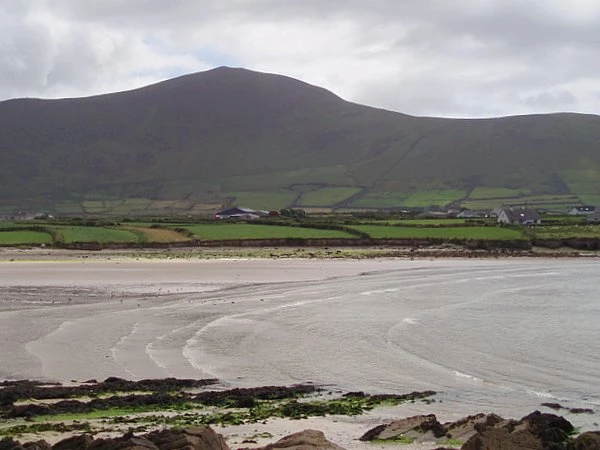
Ferriter’s Cove – Last Foragers of the Dingle Peninsula
Shell middens exposed in the low cliff at Ferriter’s Cove, near Baile an Fheirtéaraigh at the western tip of the Dingle Peninsula, County Kerry, are among the most important late Mesolithic sites in Ireland. They stretch along about 100 metres of shoreline, resting on a wave-cut platform beneath sand dunes that are several metres deep in places.
Excavation
A flint plano-convex knife found at the site in the 1970s drew attention to the cove. Excavations in 1983, 1984 and 1985, led by Professor Peter Woodman, revealed a series of settlement areas with pits, hearths and large quantities of occupation debris.
What people ate
The middens are dominated by shells, mostly whelk, limpet and periwinkle. Fish bones, and even fish scales, survived, together with bones of wild pig and red deer, a picture of people living from the sea and the surrounding land.
Tools and raw materials
Stone tools were made on site. The main raw materials were greenish-blue rhyolites and volcanic ashes that outcrop several kilometres to the south near Dún Chaoin (Dunquin), with a little flint and artefacts of slate, shale and sandstone. Finds include Bann flakes, points, chopper tools, blades, picks and stone axes.
Dating and significance
Charcoal from the site produced radiocarbon dates ranging from 3670 ± 80 b.c. to 3240 ± 110 b.c. These are uncalibrated radiocarbon determinations, reported in the convention of the original excavation; calibrated calendar dates are older. The settlements therefore straddle the Mesolithic–Neolithic transition, although the archaeological evidence shows they were essentially Mesolithic in character: some of the last hunter-gatherer communities in Ireland, living as farming began to spread.
Visiting
The cove is a public beach. The middens are fragile and part of a recorded monument (KE042-035); do not dig in or remove material from the cliff face.
Sources
National Monuments Service, Sites and Monuments Record KE042-035 (CC BY 4.0), derived from J. Cuppage, Corca Dhuibhne: Dingle Peninsula Archaeological Survey; Woodman, Duggan and McCarthy 1984; Woodman 1985.