
Ancient Ireland History and Monuments: Complete Guide
The study of ancient Ireland history and monuments reveals one of the most extensive and culturally rich archaeological landscapes in Europe. Across thousands of years, Ireland developed a continuous historical narrative shaped by migration, settlement, belief systems, and evolving social structures. Furthermore, these layers of history are still visible today through surviving monuments and archaeological sites.
In addition, from the earliest hunter-gatherer communities to the builders of monumental passage tombs such as Newgrange, Ireland preserves an uninterrupted record of human presence. As a result, ancient Ireland history and monuments provide not only archaeological evidence but also a cultural connection between past and present. This guide explores that evolution in a structured and accessible way.
Origins of Ancient Ireland History and Monuments Project
The Ancient Ireland project was originally created to bring together fragmented information on ancient Ireland history and monuments into a single, accessible resource. At the time, knowledge about archaeological sites and historical landscapes was scattered across books, archives, and local oral traditions. Consequently, it was difficult for researchers and visitors to form a complete picture of Ireland’s ancient past.
The initial aim was to develop a structured directory of monuments, linking each site to its historical period and cultural significance. Over time, however, the project naturally expanded beyond archaeology alone. It began to incorporate genealogy, which revealed how ancient Ireland history and monuments are directly connected to family lineages and clan histories across the island.
Today, the project continues to evolve as both a historical archive and genealogical resource. It connects physical heritage sites with ancestral identity, allowing users to explore Ireland’s past in a more personal and meaningful way.
Mesolithic Ireland (c. 8000–4000 BC)
The Mesolithic period represents the earliest phase of ancient Ireland history and monuments, beginning shortly after the last Ice Age. During this time, small groups of hunter-gatherers migrated into Ireland from surrounding regions such as Britain and continental Europe. These early communities adapted to dense forests, rivers, and coastal environments that defined the post-glacial landscape.
Life during this period was highly mobile and closely tied to seasonal resources. People relied on fishing, hunting, and foraging, using simple but effective stone and flint tools. Furthermore, their settlements were temporary, often located near waterways where food sources were abundant and transportation was easier.
Sites such as Mount Sandel in County Derry provide some of the strongest evidence of Mesolithic life in Ireland. As a result, this period forms the earliest foundation of ancient Ireland history and monuments, establishing the beginning of human continuity on the island.
Neolithic Ireland (c. 4000–2500 BC)
Subsequently, the Neolithic period introduced one of the most significant transformations in ancient Ireland history and monuments. Farming communities replaced mobile hunter-gatherer groups, establishing permanent settlements across the island. This shift allowed for population growth, social organisation, and long-term construction projects.
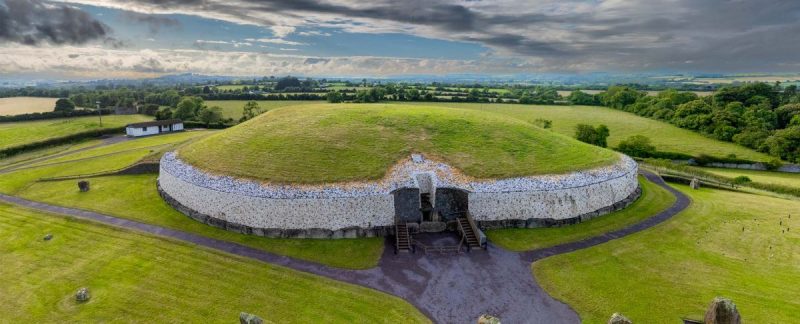
During this era, Ireland saw the emergence of its most iconic monuments. Structures such as Newgrange, Knowth, and Dowth were constructed with remarkable precision and are aligned with astronomical events such as the winter solstice. In addition, these monuments reflect a complex understanding of ritual, spirituality, and engineering.
As a result, Neolithic Ireland represents the architectural and ceremonial foundation of ancient Ireland history and monuments. These structures were not only burial sites but also expressions of belief systems that connected people to the land, the seasons, and the cosmos.
Learn more: Newgrange Passage Tomb
Bronze Age Ireland (c. 2500–500 BC)
Following the Neolithic period, the Bronze Age marked a major technological advancement in ancient Ireland history and monuments. The introduction of metalworking allowed communities to produce stronger tools, weapons, and ornamental objects. Consequently, this era is often associated with increased trade and cultural exchange across Europe.
Ireland became an important centre for copper and later bronze production, linking it to wider continental networks. Furthermore, gold artefacts such as torcs and lunulae indicate the development of wealth, craftsmanship, and social hierarchy. These items also suggest the presence of elite classes within Bronze Age society.
In contrast to earlier periods, settlement patterns became more structured, and ceremonial landscapes expanded. Hillforts, standing stones, and ritual sites became more common, reflecting both social organisation and spiritual practices.
Learn more archaeology: Heritage Ireland
Iron Age Ireland (c. 500 BC–AD 400)
Meanwhile, the Iron Age introduced significant cultural and technological changes to ancient Ireland history and monuments. Iron replaced bronze as the primary material for tools and weapons, leading to advancements in agriculture, warfare, and daily life. As a result, communities became more organised and territorially defined.
Tribal kingdoms began to emerge during this period, each governed by local rulers and warrior elites. Furthermore, oral tradition played a central role in preserving law, identity, and historical memory. These social systems laid the groundwork for later Gaelic Ireland.
The appearance of the Ogham writing system in the later Iron Age marks the earliest known form of written communication in Ireland. In addition, cultural influences associated with wider Celtic traditions gradually integrated into local society, creating a distinct Irish identity.
Early Christian Ireland (c. AD 400–800)
Afterwards, Early Christian Ireland marked a profound transformation in ancient Ireland history and monuments. Christianity gradually replaced earlier pagan belief systems, leading to the establishment of monastic communities across the island. These centres became essential hubs of religion, education, and cultural preservation.
Monasteries played a critical role in maintaining knowledge during a period of instability across Europe. For example, illuminated manuscripts such as the Book of Kells demonstrate extraordinary artistic and spiritual achievement. Furthermore, these works highlight Ireland’s contribution to early medieval scholarship.
As a result, Ireland became known as the “Island of Saints and Scholars,” reflecting its reputation for learning and religious devotion. High crosses, round towers, and monastic settlements continue to define this period within ancient Ireland history and monuments.
Viking Age Ireland (c. 800–1100)
Meanwhile, the Viking Age significantly reshaped ancient Ireland history and monuments through settlement, trade, and cultural interaction. Viking raids initially targeted coastal monasteries, but over time, many Norse groups established permanent settlements across Ireland.
Major urban centres such as Dublin, Waterford, Limerick, Wexford, and Cork were founded during this period. Furthermore, these towns became important hubs of trade, connecting Ireland to broader European and Scandinavian networks.
As a result, Viking and Gaelic societies gradually interacted through both conflict and cooperation. Eventually, cultural integration became widespread, influencing language, commerce, and daily life across the island.
Medieval / Norman Ireland (c. 1169–1500s)
Following this, the Norman invasion marked another major transformation in ancient Ireland history and monuments. The arrival of Strongbow and other Norman leaders introduced feudal systems, new legal structures, and widespread castle construction.
Over time, Norman settlers established control over large parts of Ireland, building towns, fortifications, and administrative centres. However, many of these families gradually assimilated into Gaelic culture, adopting local language and customs.
Meanwhile, Gaelic kingdoms continued to survive in many regions, maintaining traditional structures of power outside Norman-controlled areas. This created a complex cultural landscape defined by both integration and resistance.
Historical reference: Encyclopaedia Britannica
Flight of the Earls (1607)
Ultimately, the Flight of the Earls marked the end of traditional Gaelic rule in ancient Ireland history and monuments. Leading noble families left Ireland, effectively ending centuries of native aristocratic leadership and political structure.
Consequently, English governance expanded significantly across the island, bringing new administrative and cultural systems. This shift also marked the beginning of large-scale social and land ownership changes.
In addition, religious transformation accelerated during this period, further reshaping Irish society and identity in the centuries that followed.
Genealogy and Ancient Ireland History and Monuments
Importantly, genealogy is deeply connected to ancient Ireland history and monuments, linking modern individuals to ancient clans and territorial systems. These connections provide a living bridge between archaeological sites and family identity.
Furthermore, genetic evidence shows that Irish ancestry is a combination of Mesolithic, Neolithic, and Bronze Age populations. As a result, modern Irish identity reflects thousands of years of migration and cultural blending.
Clan names such as O’Hanlon and Uí Néill continue to represent historical regions and ancient social structures. Therefore, genealogy allows individuals to trace their lineage through both historical records and physical landscapes.
Start genealogy research: Irish Clan Research
Conclusion: Ancient Ireland History and Monuments
In conclusion, the study of ancient Ireland history and monuments reveals a continuous and evolving story of human settlement, culture, and identity. Each historical period contributes a distinct layer to Ireland’s archaeological and cultural landscape.
Moreover, from early hunter-gatherer communities to complex medieval societies, Ireland’s monuments preserve this long and interconnected history. These sites remain essential to understanding both national heritage and human development.
Ultimately, archaeology, mythology, and genealogy together create a complete framework for understanding Ireland’s past. As a result, this heritage continues to expand as new discoveries are made across the island.